
Holy Rosary Thursday PDF: A Comprehensive Guide
This guide details resources for a Thursday Rosary, offering downloadable PDFs containing essential Catholic prayers, like the Apostles’ Creed and Hail Mary.
Understanding the Rosary and its Significance
The Holy Rosary is a deeply cherished Catholic devotion, a meditative prayer form centered on contemplating the mysteries of Jesus Christ’s life, alongside the Virgin Mary. It’s more than just reciting prayers; it’s a spiritual journey. PDF resources for the Thursday Rosary facilitate this practice, providing a structured format for personal or communal prayer.

Historically, the Rosary evolved from the practice of reciting the Psalms. Its significance lies in its ability to foster contemplation, repentance, and a closer relationship with God. The beads themselves serve as tactile aids, guiding the prayer and preventing distraction. Thursday’s devotion specifically focuses on the Luminous Mysteries, highlighting Christ’s public ministry and revealing His divine glory. Accessing a Thursday Rosary PDF simplifies participation, offering convenience and clarity for believers seeking this powerful spiritual practice.
The Specificity of Thursday Rosary Devotion
Thursday is uniquely dedicated to the Luminous Mysteries of the Rosary, a focus introduced by Pope John Paul II in 2002. These mysteries – Baptism, Cana, Proclamation of the Kingdom, Transfiguration, and the Eucharist – illuminate Jesus’s public life. A Thursday Rosary PDF will specifically guide you through these events, encouraging meditation on Christ’s teachings and miracles.
This devotion isn’t arbitrary; it’s rooted in a desire to deepen understanding of Christ’s revelation. PDFs designed for Thursday prayer often include reflections tailored to these mysteries, enhancing the meditative experience. Choosing a Thursday Rosary PDF ensures you’re aligning with this specific tradition, fostering a richer connection to the luminous aspects of Christ’s earthly journey and His divine presence.

PDF Availability and Sources for Thursday Rosary

Numerous online sources offer free Thursday Rosary PDFs for download. Websites dedicated to Catholic prayer and devotion, like those affiliated with parishes or religious orders, frequently provide these resources. A simple web search for “Thursday Rosary PDF” yields many options, ranging from basic prayer outlines to more elaborate booklets.
PDFs can also be found on platforms like Scribd and similar document-sharing sites. However, verifying the source’s authenticity is crucial. Look for PDFs originating from reputable Catholic organizations to ensure accuracy and adherence to Church teachings. Printing these PDFs allows for convenient, offline prayer, making the Rosary accessible anytime, anywhere. Always ensure your download is safe and from a trusted provider.
Core Prayers Included in a Thursday Rosary PDF
A standard Thursday Rosary PDF invariably includes foundational Catholic prayers. Central to these is the Apostles’ Creed, a profession of faith. The Our Father (Lord’s Prayer), taught by Jesus, is recited on each decade’s beginning. The Hail Mary, a prayer honoring the Virgin Mary, forms the core of each decade;
Completing each decade is the Glory Be, a doxology praising the Holy Trinity. Many PDFs also incorporate introductory and concluding prayers, such as acts of contrition and prayers for the Pope. These core prayers provide the structure for meditative reflection on the Luminous Mysteries, specific to Thursdays, fostering a deeper connection with God.
The Apostles’ Creed
The Apostles’ Creed, a cornerstone of Catholic faith, is prominently featured in Thursday Rosary PDFs. It’s a concise declaration of core Christian beliefs, outlining faith in God the Father, Jesus Christ, and the Holy Spirit. Reciting this creed before beginning the Rosary establishes a foundation of belief and intention.

The Creed affirms belief in the Holy Catholic Church, the forgiveness of sins, and the resurrection of the body. It’s a historical summary of Christian doctrine, tracing back to the early Church. Its inclusion in the Rosary emphasizes the importance of shared faith and provides a unified starting point for prayerful contemplation. It’s a powerful statement of belief recited before embarking on the mysteries.
The Our Father (Lord’s Prayer)
The Our Father, or Lord’s Prayer, is a central component of any Rosary, and therefore consistently included in Thursday Rosary PDFs. Given to the disciples by Jesus himself, it’s considered the perfect prayer, encompassing adoration, petition, and intercession. It’s recited at the beginning of each decade of the Rosary, linking each set of Hail Marys to a direct address to God.
The prayer’s structure guides believers to acknowledge God’s holiness, seek His kingdom, and ask for daily sustenance. It also includes requests for forgiveness and protection from temptation. Its presence in Rosary PDFs underscores its fundamental importance in Catholic prayer life, fostering a deeper connection with God through its familiar and profound words.
The Hail Mary
The Hail Mary is the most frequently recited prayer within the Rosary, and is therefore a cornerstone of any Thursday Rosary PDF. This prayer beautifully combines praise for the Virgin Mary with a plea for her intercession. It begins with the Angel Gabriel’s greeting to Mary – “Hail, Mary, full of grace, the Lord is with thee” – and continues with the affirmation of her blessedness among women and her role as the mother of Jesus.
The concluding request, “Pray for us, Holy Mother of God,” highlights Mary’s powerful role as a mediator. Thursday Rosary PDFs invariably feature this prayer repeated ten times per decade, fostering contemplation and a deepening relationship with both Mary and her Son, Jesus Christ.
The Glory Be
The “Glory Be” prayer, also known as the “Gloria Patri,” is a traditional doxology concluding each decade of the Rosary and is consistently included in Thursday Rosary PDFs. This ancient hymn offers praise and glory to the Holy Trinity – God the Father, God the Son, and God the Holy Spirit – for all eternity. Its concise yet profound wording encapsulates the core belief in one God in three divine persons.
Within a Rosary PDF, the “Glory Be” serves as a moment of thanksgiving and adoration, reinforcing the central focus on God’s majesty. Reciting it after each set of ten Hail Marys provides a structured rhythm to the prayer and a powerful affirmation of faith, solidifying its importance in devotional practice.
The Luminous Mysteries for Thursdays

Thursday Rosary PDFs specifically dedicate themselves to the Luminous Mysteries, introduced by Pope John Paul II in 2002. These mysteries focus on key events in Jesus’ public ministry, illuminating his divine identity and mission. A typical PDF will outline each mystery with a brief description for meditation.
The sequence begins with the Baptism of Jesus in the Jordan River, followed by the Wedding at Cana, where Jesus performed his first miracle. The Proclamation of the Kingdom of God, the Transfiguration, and finally, the Institution of the Eucharist complete the set. These mysteries, central to Thursday devotion, encourage reflection on Jesus’ teachings and transformative power, readily available within downloadable resources.
First Luminous Mystery: The Baptism of Jesus

Thursday Rosary PDFs dedicate a section to the Baptism of Jesus, the first Luminous Mystery. This event, detailed within the downloadable guides, marks the beginning of Christ’s public ministry and reveals the Holy Trinity – Father, Son, and Holy Spirit.
The PDF materials often include a short meditation prompt, encouraging reflection on Jesus’ humility in receiving baptism from John the Baptist. It highlights the voice from heaven proclaiming, “This is my beloved Son, with whom I am well pleased.” Contemplating this mystery within the Rosary PDF fosters a deeper understanding of Jesus’ divine nature and his identification with humanity, offering spiritual enrichment for the faithful.
Second Luminous Mystery: The Wedding at Cana
Thursday Rosary PDFs consistently feature the Wedding at Cana as the second Luminous Mystery, a pivotal moment in Jesus’ ministry. These downloadable resources emphasize this event as the first public miracle performed by Jesus, transforming water into wine and revealing his divine power.
The accompanying meditations within the PDF guides often focus on Mary’s role in prompting Jesus to perform the miracle, highlighting her faith and intercession. Reflecting on this mystery encourages believers to trust in God’s provision and to seek Mary’s guidance. The PDF materials underscore the significance of this event as a sign of the coming Kingdom and a demonstration of Jesus’ love for humanity.
Third Luminous Mystery: The Proclamation of the Kingdom of God
Thursday Rosary PDFs dedicate the third Luminous Mystery to Jesus’ proclamation of the Kingdom of God, a central theme of his teachings. These downloadable guides emphasize the importance of repentance and faith as prerequisites for entering this Kingdom.
PDF resources often highlight Jesus’ call to conversion, urging individuals to turn away from sin and embrace a life of holiness. Meditations within these materials encourage reflection on the implications of living under God’s reign, emphasizing justice, mercy, and love. The downloadable PDFs frequently include scriptural references from the Gospels, particularly Matthew and Mark, to deepen understanding of this crucial aspect of Jesus’ message.
Fourth Luminous Mystery: The Transfiguration
Thursday Rosary PDFs devote the fourth Luminous Mystery to the Transfiguration of Jesus, a pivotal event revealing his divine glory. These downloadable resources emphasize the significance of this manifestation to Peter, James, and John, showcasing Jesus’ true identity as the Son of God.
PDF guides often highlight the connection between the Transfiguration and the anticipation of Jesus’ Passion and Resurrection, offering a glimpse of his ultimate triumph over death. Meditations encourage reflection on the transformative power of faith and the call to witness Christ’s glory in our own lives. Scriptural passages from the Gospels, particularly Luke, are frequently included to enhance understanding of this profound mystery.
Fifth Luminous Mystery: The Institution of the Eucharist
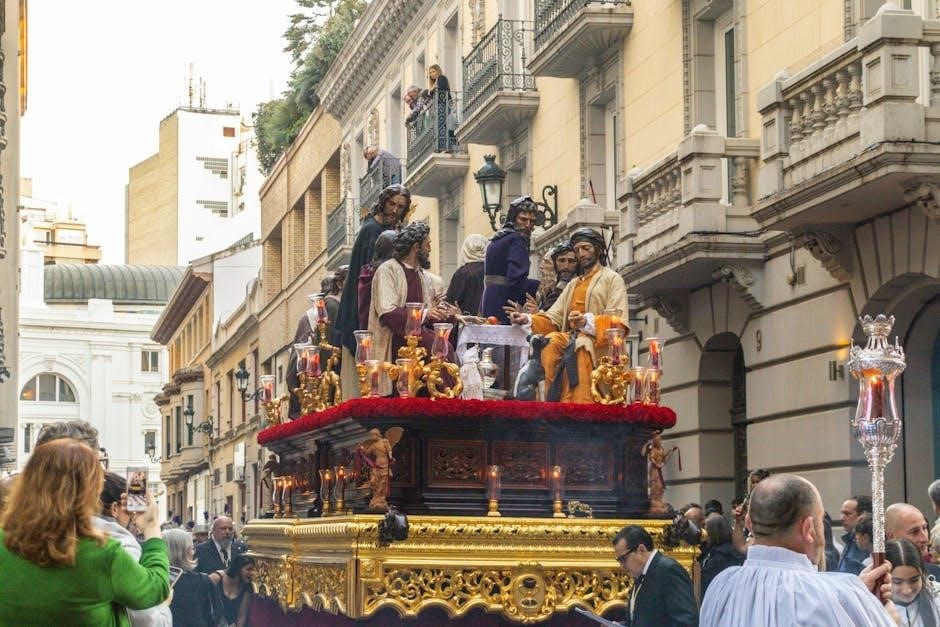
Thursday Rosary PDFs dedicate the fifth Luminous Mystery to the profound event of the Institution of the Eucharist, during the Last Supper. These resources emphasize Jesus’ command to “Do this in remembrance of me,” highlighting the central importance of the Eucharist in Catholic faith.
PDF guides often explore the Real Presence of Christ in the Eucharist, emphasizing it as not merely a symbolic meal, but the actual body and blood of Jesus. Meditations encourage reflection on the sacrifice of Christ and the gift of eternal life offered through Holy Communion. Scriptural references from Matthew, Mark, Luke, and Paul are commonly included, deepening understanding of this sacred mystery and its significance for believers.
Additional Prayers Often Found in Rosary PDFs
Many Thursday Rosary PDFs extend beyond the core prayers, incorporating supplemental devotions for enhanced spiritual practice. The Fatima Prayer, a plea for peace and the conversion of sinners, is a frequent addition, honoring the apparitions at Fatima.
“Hail, Holy Queen,” a Marian hymn invoking Mary’s intercession, is also commonly included, expressing devotion and seeking her maternal guidance. Some PDFs may feature prayers for specific intentions, such as healing or guidance, or prayers dedicated to saints. These additions enrich the Rosary experience, offering a more comprehensive and personalized devotional practice, readily available in downloadable formats.

The Fatima Prayer
The Fatima Prayer, revealed by Our Lady during the 1917 apparitions at Fatima, Portugal, is a central component of many Rosary PDFs, particularly those for Thursdays. This powerful prayer implores the Immaculate Heart of Mary to intercede for peace worldwide and the salvation of souls.
Its recitation is a direct response to Mary’s request, aiming to convert sinners and foster a deeper devotion to her Immaculate Heart. The prayer’s inclusion in Rosary resources underscores its significance within Catholic devotion. It’s a plea for divine mercy and a commitment to personal penance, often recited at the conclusion of the Rosary, reinforcing its message of hope and redemption.
Hail, Holy Queen
“Hail, Holy Queen,” a traditional Marian hymn, frequently concludes Rosary prayers found within Thursday Rosary PDFs. This ancient hymn expresses profound reverence and supplication to the Virgin Mary, acknowledging her role as the Mother of God and Queen of Heaven.
Its inclusion signifies a final act of devotion, seeking Mary’s intercession and blessing upon those who have prayed the Rosary. The prayer beautifully articulates the faithful’s hope for eternal life and asks for Mary’s compassionate guidance. Many PDF versions offer the prayer in both Latin and English, catering to diverse preferences. It’s a timeless expression of Catholic faith and a fitting end to contemplative prayer.
Variations in Thursday Rosary PDFs
Thursday Rosary PDFs exhibit variations in formatting, supplemental prayers, and devotional content. Some PDFs prioritize simplicity, presenting only the core Rosary prayers and Luminous Mysteries. Others include additional prayers like the Litany of Loreto or prayers for specific intentions.
Different publishers may employ varying fonts, layouts, and artistic elements. Some PDFs are designed for personal use, while others are intended for group recitation. The inclusion of explanations of the mysteries, or theological reflections, also differs. Variations can also stem from different religious orders or dioceses offering their preferred versions. Ultimately, these PDFs all aim to facilitate a meaningful Rosary experience.
Downloading and Printing Thursday Rosary PDFs
Downloading Thursday Rosary PDFs is typically straightforward, often available from Catholic websites, parish resources, or online devotional platforms. A simple web search for “Thursday Rosary PDF” yields numerous options. Ensure the source is reputable to guarantee accuracy and adherence to Church teachings.
Once downloaded, printing is generally easy using standard printer settings. Consider printing on cardstock for durability, especially for frequent use. Many PDFs are formatted for double-sided printing to conserve paper. Adjusting print scaling may be necessary to fit the text comfortably on the page. Having a physical copy allows for distraction-free prayer and convenient sharing with others.
Historical Context of Rosary Prayers and Texts
The roots of the Rosary trace back to the early centuries of Christianity, evolving from the practice of reciting the Psalms. The individual prayers—Our Father and Hail Mary—have ancient origins, predating the formalized Rosary. The structure of 15 mysteries developed gradually, becoming standardized in the 16th century.
Early texts, like the Aitareya Brahmanam, demonstrate a long tradition of meditative prayer. The Rosary’s association with specific days, like Thursday’s focus on the Luminous Mysteries, emerged later, reflecting theological emphases. Historical documents reveal the Rosary’s role in times of crisis, such as during the threat of invasion, and its connection to Marian apparitions.
The Rosary and Catholic Rituals
The Rosary is deeply interwoven with Catholic devotional life, serving as a central private prayer practice. It’s often recited before or after Mass, during Adoration, and within family settings. The Rosary complements liturgical celebrations, enhancing understanding of Gospel messages through meditative reflection on the mysteries.
Its use extends to specific rituals, like those surrounding death and mourning, offering comfort and spiritual support. The Rosary’s communal aspect fosters unity among the faithful, as evidenced by public Rosary recitations. PDF resources facilitate participation, making the Rosary accessible for individual and group prayer, strengthening the connection to Catholic traditions.